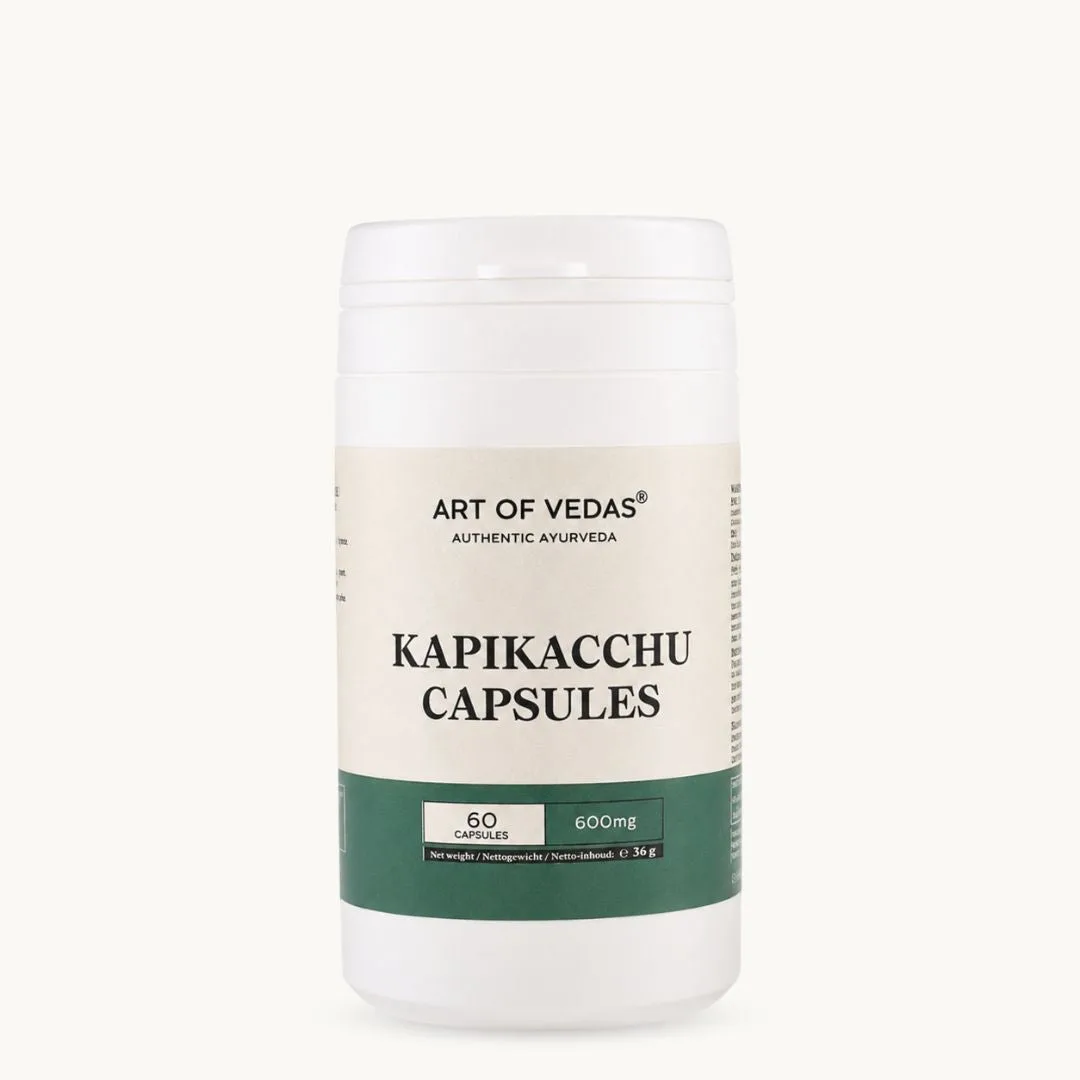
Kapikacchu, the velvet bean of classical Ayurveda, is a climbing legume whose seeds have held a respected place in the tradition for many centuries. Known also as Atmagupta, the self-protected one, it is a herb wrapped in vivid names and long custom. This monograph sets out its botanical identity, its classical character, the forms in which it is prepared, and the respectful context Ayurveda gives it.
Botanical identity
Kapikacchu is the seed of Mucuna pruriens, a vigorous climbing legume of tropical India. The plant is well known for the fine hairs on its young pods, which give the velvet bean its common name and which lie behind the Sanskrit Kapikacchu, an image of an itch that even a monkey would scratch. In classical use the seed is carefully processed to remove these hairs, and it is the cleaned, powdered seed that enters the pharmacopoeia.
Classical Ayurvedic role
The Nighantu literature describes Kapikacchu as carrying Madhura and Tikta Rasa, a sweet and bitter taste, with an Ushna or warming Virya and a Madhura Vipaka. Within this framework it is traditionally counted among the Vrishya and Balya herbs, those classically associated with vitality and strength, and among the Vata-steadying botanicals. Classical texts place it in the context of nourishing, building practice. These are descriptions of the herb's traditional qualities and role within Ayurveda, not claims of clinical action.
Traditional preparation forms
- As a Churnam, the cleaned seed finely powdered and taken with a suitable Anupana such as warm water or, traditionally, a milk-based vehicle.
- Within classical compound formulas that pair it with other Rasayana and Balya herbs.
- As a processed seed preparation, since classical method places emphasis on correct cleaning before use.
- In the modern capsule, which carries the powdered seed in a convenient daily form.
How Kapikacchu appears in Art of Vedas formulations
In prose, Kapikacchu reaches the Art of Vedas range as capsules, offering the powdered seed in a straightforward daily format that keeps the traditional herb accessible. It belongs to the broad family of vitality-associated Rasayana botanicals, and it sits comfortably beside other classical strength herbs on the shelf, most naturally alongside Ashwagandha, with which it shares a Balya and Vrishya classical grouping. You can view Kapikacchu capsules and the companion Ashwagandha capsules. For the wider context, see the guide on choosing between Ashwagandha forms, the Churnam powder formulation guide, and the related Gokshura monograph.
Respectful cultural context
Kapikacchu carries an air of quiet regard in the tradition, reflected in its many names and in the care its preparation demands. Art of Vedas presents it as a classical herb with a long and documented history, to be approached thoughtfully and, where personal use is considered, with the guidance of a qualified practitioner.
Frequently Asked Questions
What is the botanical name of Kapikacchu?
Kapikacchu is Mucuna pruriens, a climbing legume of tropical India known as the velvet bean. The cleaned, processed seed is the part used in classical Ayurveda.
Why is Kapikacchu called the velvet bean?
The name refers to the fine hairs on the young pods. The Sanskrit Kapikacchu evokes an itch a monkey would scratch, and classical processing carefully removes these hairs before the seed is used.
What are the classical qualities of Kapikacchu?
The Nighantu literature describes it as Madhura and Tikta in Rasa, with an Ushna warming Virya and a Madhura Vipaka. It is traditionally grouped among the Vrishya and Balya herbs associated with vitality and strength.
In what forms is Kapikacchu traditionally used?
It appears as a Churnam powder, within classical compound formulas, as a carefully processed seed preparation, and in the modern capsule that offers the powdered seed in convenient daily form.
Which Art of Vedas product contains Kapikacchu?
Art of Vedas offers Kapikacchu as capsules, presenting the traditional powdered seed in a simple daily format alongside other classical Rasayana herbs.
This product is a food supplement and not intended to diagnose, treat, cure or prevent any disease.