
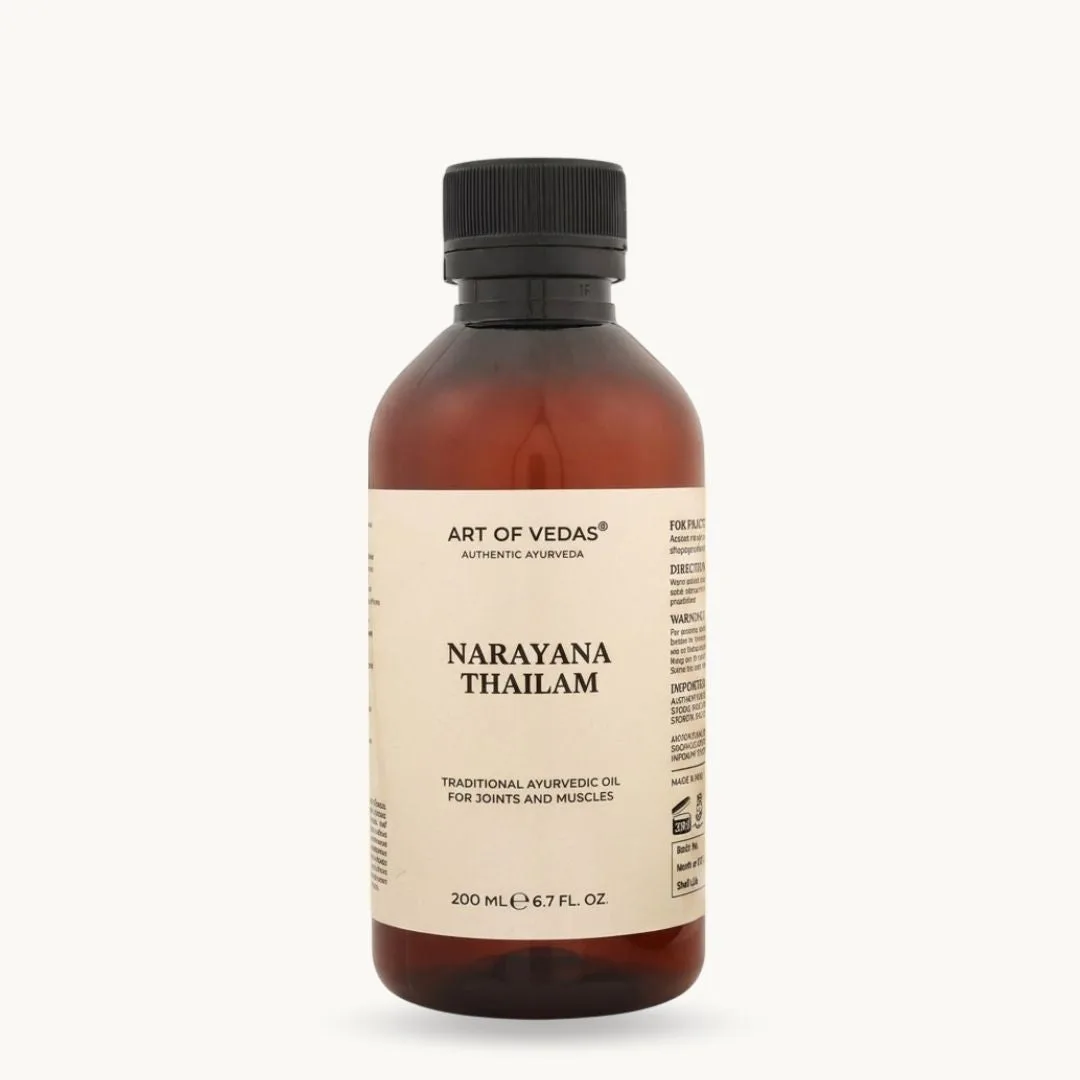
Narayana Thailam

(1)

Classical Ayurvedic Oil for Neuromuscular Strength & Joint Comfort

€20,00

Narayana Thailam es una formulación clásica ayurvédica mencionada en el Bhaishajya Ratnavali para el apoyo neuromuscular y articular. Este potente aceite combina el completo Dashamoola (diez raíces), Ashwagandha y Punarnava de doble potencia, junto con hierbas nervinas tradicionales como Bala y Shatavari en una base nutritiva de aceite de sésamo.

Nombrado en honor al Señor Narayana (Vishnu), este aceite se ha utilizado tradicionalmente durante siglos para apoyar la fuerza muscular, la comodidad articular y el equilibrio del sistema nervioso. La fórmula cálida y profundamente penetrante es ideal para masajes Abhyanga y es especialmente valorada en Ayurveda para apoyar a quienes experimentan debilidad, rigidez o un desequilibrio general de Vata.

Contenido Neto

INGREDIENTES

Lacca, Asparagus Racemosus Powder, Sesamum Indicum Oil, Aegle Marmelos Extract, Premna Corymbosa Extract, Oroxylum Indicum Extract, Stereospermum Colais Extract, Erythrina Variegata Extract, Paederia Foetida Extract, Withania Somnifera Extract, Solanum Indicum Extract, Solanum Xanthocarpum Extract, Sida Cordifolia Extract, Abutilon Indicum Extract, Tribulus Terrestris Extract, Boerhaavia Diffusa Extract, Anethum Sowa Powder, Cedrus Deodara Powder, Parmelia Perlata Powder, Elettaria Cardamomum Powder, Pseudarthria Viscida Powder, Desmodium Gangeticum Powder, Vigna Pilosa Powder, Vigna Radiata Powder, Alpinia Galanga Powder, Withania Somnifera Polvo, cloruro de sodio, boerhaavia diffusa polvo.

Narayana Thailam

€20,00

€20,00

Narayana Thailam - Art of Vedas

¿Por qué usar Narayana Tailam?

Narayana Thailam stands as one of the foundational therapeutic oils in classical Ayurveda, predating even the more elaborate Mahanarayana formulation. Referenced in the Bhaishajya Ratnavali under Vatavyadhi Chikitsa (treatment of Vata disorders), this oil represents centuries of traditional knowledge for supporting the musculoskeletal and nervous systems.

What sets Narayana Thailam apart is its comprehensive yet balanced approach. With 27 Ayurvedic herbs including the complete Dashamoola, this formulation addresses Vata imbalance at multiple levels, from the surface muscles to the deeper nervous tissue.

The Complete Dashamoola: Ten Roots Working Together

At the heart of Narayana Thailam lies Dashamoola, the famous Ayurvedic combination of ten roots that has been revered for millennia. This formula contains both the Brihat Panchamoola (five larger tree roots) and Laghu Panchamoola (five smaller plant roots), providing comprehensive Vata-pacifying action.

The Brihat Panchamoola includes Bilva (Aegle marmelos), Agnimantha (Premna corymbosa), Shyonaka (Oroxylum indicum), Patala (Stereospermum colais) and Paribhadra (Erythrina variegata). These larger roots are traditionally associated with deeper, more substantial action on the body's framework.

The Laghu Panchamoola comprises Brihati (Solanum indicum), Kantakari (Solanum xanthocarpum), Gokshura (Tribulus terrestris), Shalaparni (Desmodium gangeticum) and Prishnaparni (Pseudarthria viscida). These lighter roots complement the formula with their own unique properties.

Together, the complete Dashamoola is traditionally understood to pacify Vata dosha, support comfortable movement and promote overall structural wellbeing.

Traditional Uses

Narayana Thailam has been traditionally used in Ayurveda for:

  • Supporting comfortable movement in joints and muscles
  • Promoting muscle strength and tone
  • Supporting the nervous system
  • Full-body Abhyanga massage for Vata balance
  • Local application to areas of discomfort
  • Panchakarma therapies including Basti and Nasya (under practitioner guidance)

Who Benefits Most

Narayana Thailam may be particularly suitable for:

  • Those experiencing muscle weakness or fatigue
  • Individuals seeking support for joint comfort and mobility
  • Those with predominantly Vata constitution or Vata imbalance
  • People recovering from physical exertion
  • Anyone seeking a traditional strengthening oil for regular Abhyanga
  • Those looking for neuromuscular support as part of their wellness routine

Cómo usar Narayana Thailam

Calienta suavemente el aceite y aplícalo sobre el cuerpo o en áreas afectadas como la espalda, los hombros, las piernas o las articulaciones. Masajea usando trazos firmes y circulares hasta que se absorban. Permita que el aceite permanezca en el cuerpo durante 20-30 minutos antes de bañarse. Use diariamente o según lo indique su practicante ayurvédico.

Referencia clásica de Ayurveda

Narayana Thailam is documented in the Bhaishajya Ratnavali, a comprehensive 18th-century Ayurvedic text compiled by Kaviraj Govinda Das Sen. The formulation appears in the Vatavyadhi Chikitsa chapter, which addresses disorders arising from Vata dosha imbalance.

The oil is also referenced in Sahasrayogam, a classical Kerala text containing thousands of Ayurvedic formulations, and is included in the Ayurvedic Formulary of India (AFI), the official government compendium of standardized Ayurvedic preparations.

Notably, Narayana Thailam is considered the parent formulation from which the more elaborate Mahanarayana Thailam later evolved through the addition of more herbs.

Sanskrit Name and Etymology

Sanskrit: नारायण तैलम् (Nārāyaṇa Tailam)

The name combines:

  • Nārāyaṇa: A name of Lord Vishnu, the preserver deity in Hindu tradition, signifying the oil's preserving and protective qualities
  • Taila/Thailam: Medicated oil

The divine name reflects the high regard in which this formulation has been held, suggesting therapeutic power of the highest order.

Classical Indications

In classical Ayurvedic texts, Narayana Thailam is indicated for:

  • Pakshaghata - Hemiplegia, paralysis affecting one side of the body
  • Ardita - Facial paralysis, Bell's palsy type conditions
  • Gridhrasi - Sciatica and radiating leg discomfort
  • Sandhigata Vata - Joint disorders, degenerative conditions
  • Manyastambha - Neck stiffness and cervical conditions
  • Katishoola - Lower back discomfort
  • Vatavyadhi - General Vata disorders affecting movement and sensation

Classification

Narayana Thailam is classified as:

  • Vatahara Thailam - Vata-pacifying oil
  • Balya - Strength-promoting
  • Brimhana - Nourishing, building
  • Bahya Prayoga - External application
  • Abhyantara Prayoga - Internal use (under practitioner guidance only)

Ayurvedic Pharmacology (Dravyaguna)

Rasa (Taste): Predominantly Tikta (bitter), Kashaya (astringent), Madhura (sweet)

Guna (Qualities): Snigdha (unctuous), Guru (heavy), Ushna (warming)

Virya (Potency): Ushna (warm), balanced by cooling herbs like Shatavari and Shaileyaka

Vipaka (Post-digestive effect): Madhura (sweet)

Dosha Action:

  • Vata Shamaka (strongly pacifies Vata) - Primary action
  • Kapha Shamaka (mildly pacifies Kapha) - Secondary action
  • Generally neutral to mildly aggravating for Pitta when used externally in moderation

Karma (Actions)

  • Vatahara - Pacifies Vata dosha
  • Vedanasthapana - Promotes comfort and ease
  • Shothahara - Supports normal inflammatory response
  • Balya - Promotes strength
  • Brimhana - Nourishes and builds tissues
  • Srotoshodhana - Supports channel clarity

Dhatu (Tissue) Affinity

Narayana Thailam has particular affinity for:

  • Mamsa Dhatu - Muscle tissue
  • Asthi Dhatu - Bone tissue
  • Majja Dhatu - Nerve tissue and marrow

Panchakarma Applications

In traditional Ayurvedic Panchakarma therapy, Narayana Thailam is used for:

  • Abhyanga - Therapeutic oil massage
  • Matra Vasti - Oil enema therapy (50ml daily, 7-14 days)
  • Nasya - Nasal administration (8 drops per nostril)
  • Shirovasti - Head oil retention therapy
  • Shirodhara - Continuous oil stream on forehead
  • Kati Vasti - Lower back oil pool therapy

Note: These Panchakarma applications should only be performed by or under the supervision of qualified Ayurvedic practitioners.

Preguntas frecuentes sobre Narayana Thailam

Narayana Thailam is a classical Ayurvedic oil traditionally used to support neuromuscular health, joint comfort and overall Vata balance. It contains the complete Dashamoola (ten roots) along with strengthening herbs like Ashwagandha and Bala. The oil is used for Abhyanga massage, local application to areas of muscle or joint discomfort, and in various Panchakarma therapies. It is particularly valued in Ayurveda for supporting muscle strength, comfortable movement and nervous system balance.

Narayana Thailam traditionally supports neuromuscular health, joint comfort and overall Vata balance. The complete Dashamoola and strengthening herbs like Ashwagandha and Bala may help promote muscle strength and tone, support comfortable movement, ease stiffness after physical activity, and nourish the nervous system. When used for regular Abhyanga massage, this warming oil helps counteract the cold, dry qualities of Vata dosha, leaving the body feeling grounded, supple and supported.

Yes, Narayana Thailam can be used daily for targeted support, typically for periods of 2-4 weeks. For general wellness and maintenance, 2-3 times per week is usually sufficient. Always warm the oil before application. Daily use is particularly beneficial during Vata season (autumn and early winter) or during times of increased physical activity. If you plan extended daily use, consulting with an Ayurvedic practitioner can help ensure the oil remains suitable for your constitution and needs.

Store Narayana Thailam in a cool, dry place away from direct sunlight. Keep the bottle tightly closed when not in use. Room temperature storage is ideal; avoid extreme heat or cold. The oil does not require refrigeration under normal conditions. With proper storage, the oil maintains its quality throughout its shelf life. Always check for any changes in colour, consistency or smell before use, and use within the recommended period after opening.

Narayana Thailam is primarily formulated for Vata dosha and Vata-related imbalances. Its warming, unctuous nature directly counteracts Vata's cold, dry, light qualities. The oil is also suitable for Vata-Kapha dual constitutions and can mildly pacify Kapha. Those with high Pitta or acute inflammatory conditions with heat should use with caution or consult a practitioner, though the inclusion of cooling herbs like Shatavari and Shaileyaka provides some balance. For most people with joint stiffness, muscle weakness or general Vata imbalance, Narayana Thailam is an excellent choice.

Consult your healthcare provider or qualified Ayurvedic practitioner before using Narayana Thailam during pregnancy. While the oil is generally considered safe for external use and contains nourishing herbs like Shatavari, it also includes warming herbs and is traditionally used for conditions that may not be relevant during pregnancy. Practitioners often recommend gentler alternatives like Dhanwantharam Thailam for prenatal care. Any internal use, Nasya or Panchakarma applications during pregnancy should only be undertaken under professional supervision.